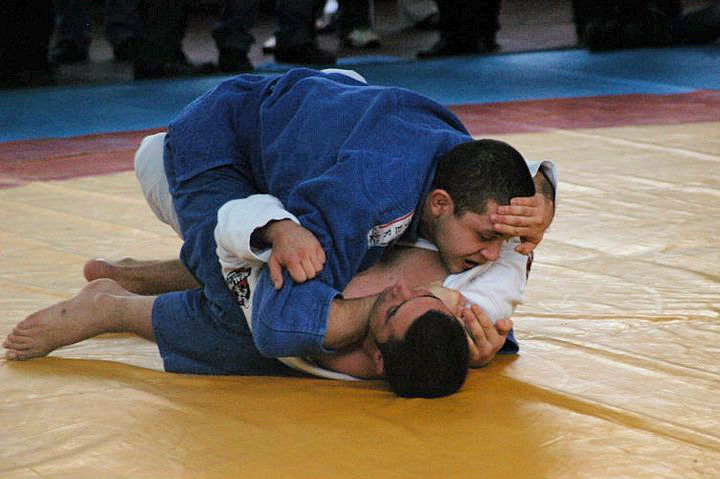
If you could only master one position in your first year of Brazilian Jiu-Jitsu, the closed guard would be a strong choice. It's safe, it's high-percentage, and it teaches the core principles — posture, grips, angle, and off-balancing — that carry into every other part of your game. This guide breaks down what the closed guard is, the details that make it work, the attacks worth learning first, and a concrete drilling plan to build it.
What is the closed guard?
The closed guard is a bottom position where you're on your back with your legs wrapped around your opponent's torso and your ankles crossed behind their back. By locking your legs, you control the distance and stop them from passing. Far from being defensive, it's one of the most offensive positions in jiu-jitsu — a well-developed closed guard threatens sweeps and submissions constantly.
The details that make it work
Beginners often treat closed guard as just "holding on." The players who are dangerous from here obsess over a few details:
- Break their posture. A posted-up, upright opponent is safe. Your first job is always to pull them down — with your legs, your grips, or both. A broken-down opponent can't pass and can't defend well.
- Win the grips. Control the collar and a sleeve, or both sleeves, or a collar and an elbow. Whoever controls the grips controls the exchange.
- Get the angle. Square-on, you have little power. Pivot your hips out to create an angle and your attacks open up dramatically.
- Stay active. A static guard gets passed. Constant grip-fighting and hip movement keep you a step ahead.
The first attacks to learn
Resist the urge to collect twenty techniques. Pick a small number of complementary attacks and drill them until they're automatic. A classic beginner trio:
1. The scissor sweep
Off-balance your opponent, get an angle, and use a scissoring action of your legs — one knee across, one leg chopping low — to sweep them sideways and come up on top. It teaches the off-balancing and angle principles better than almost any other move.
2. The cross-collar choke
A deep collar grip with both hands forms a powerful strangle. Even when you don't finish it, threatening the choke breaks their posture and sets up everything else.
3. The armbar from guard
When your opponent posts an arm or defends the choke, the armbar is right there. The choke and armbar form a natural "if they defend this, I hit that" combination — the foundation of a real offensive system.
Notice how these three link together: the choke threat breaks posture, the defense to the choke opens the armbar, and resisting the armbar opens the sweep. That's a system, not a list.
A four-week drilling plan
Here's a simple progression to turn the closed guard from theory into a reflex. Drill with a cooperative partner first, then add light resistance.
| Week | Focus | Drilling priority |
|---|---|---|
| 1 | Posture control | Breaking your partner down + recovering grips, 10 min |
| 2 | Scissor sweep | 40+ reps per side, slow to fast |
| 3 | Cross-collar choke | Grip depth and finishing mechanics |
| 4 | Choke → armbar → sweep | Chaining the three together off your partner's reactions |
The reason this works is volume. A focused drilling round gives you dozens of clean repetitions you'd never accumulate in live rolling — the exact argument we make in Why Drilling Beats Rolling for Beginners.
Don't neglect the solo work
Your closed guard depends on hip mobility and the ability to create angles. You can sharpen both at home with shrimping, hip switches, and bridging — see 12 BJJ Solo Drills You Can Do at Home. Better hips mean better angles, and better angles mean a more dangerous guard.
Track your reps
The closed guard rewards repetition more than almost any position. Logging your drilling in DrillBuddy — and tagging each move by position — lets you see at a glance how many reps you've banked on the scissor sweep versus the armbar, so you can shore up the weak links. You can also browse curated drills to add structure to each session.
Pick the scissor sweep, drill it forty times tomorrow, and start building a guard people don't want to be inside.